 Maple
Maple Peptide solubility is one of the most common practical challenges in research peptide work, and poor dissolution technique is a leading cause of failed experiments that gets blamed on peptide quality. Understanding the physicochemical principles that govern peptide solubility, including amino acid composition, isoelectric point, pH selection, and solvent compatibility, is essential for any researcher working with lyophilized peptide materials. This guide covers the foundational science behind peptide dissolution and provides research-backed guidelines for optimizing solubility across different peptide classes commonly used in Canadian research laboratories.
For research purposes only. Not for human consumption. Not for diagnostic or therapeutic use.
Why Peptide Solubility Matters for Research Outcomes
A peptide that fails to dissolve fully introduces immediate experimental confounds: inconsistent concentrations across aliquots, aggregation-induced loss of biological activity, and adsorption to container surfaces. According to formulation guidelines published by Bachem, one of the largest peptide manufacturers globally, researchers should evaluate the amino acid composition of any peptide before adding solvent, because the primary sequence is the single strongest predictor of solubility behavior.
The practical impact is significant. A peptide with 60% hydrophobic residues that is dissolved in pure water may appear to go into solution initially, only to aggregate and precipitate within hours. This yields a solution with an actual concentration far below the calculated value, and any downstream assay data becomes unreliable. Getting dissolution right is not optional; it is a prerequisite for valid experimental design.
Amino Acid Composition and Solubility Prediction
The single most important factor in predicting peptide solubility is the ratio of hydrophobic to hydrophilic residues. Industry-standard guidelines from Sigma-Aldrich and Bachem establish clear thresholds:
- Readily soluble in water: Peptides with fewer than 25% hydrophobic residues (A, V, I, L, M, F, W, P) and more than 25% charged residues (D, E, K, R, H) typically dissolve in aqueous buffers without difficulty
- Marginally soluble: Peptides with 25-50% hydrophobic content may require pH adjustment, co-solvents, or sonication to achieve full dissolution
- Poorly soluble: Peptides exceeding 50% hydrophobic residues are often insoluble or only partially soluble in aqueous solutions and require organic co-solvent strategies
A practical design guideline used across the peptide synthesis industry recommends that at least 1 in every 5 amino acids should carry a charge at the target pH to maintain adequate solubility. This is why many research peptides include terminal modifications or charged residue substitutions that do not alter the pharmacologically active sequence but substantially improve handling characteristics.
The Isoelectric Point: The Critical pH to Avoid
Every peptide has an isoelectric point (pI), the pH at which the molecule carries zero net charge. At this pH, electrostatic repulsion between peptide molecules reaches its minimum, and solubility is at its lowest. The relationship between pH and solubility follows a characteristic U-shaped curve: solubility decreases as pH approaches the pI from either direction and is minimal at the pI itself.
A 2023 study published in the Journal of Chemical Information and Modeling introduced the pIChemiSt tool for calculating isoelectric points of modified peptides, noting that accurate pI prediction is essential for formulation development and purification optimization (Krajnc et al., 2023, JCIM 63(1):197-209). The tool accounts for non-natural amino acids and chemical modifications that shift pI values away from predictions based on natural amino acid pKa tables alone.
The practical rule: select a dissolution pH that is at least 2 full pH units away from the peptide’s calculated pI. At this distance, the peptide is fully protonated (if below pI) or deprotonated (if above pI), maximizing the net charge and therefore the electrostatic repulsion that keeps molecules in solution.
For common research peptides:
- Basic peptides (pI > 7, rich in K, R, H): dissolve best in mildly acidic solutions (0.1% acetic acid, pH ~3-5)
- Acidic peptides (pI < 7, rich in D, E): dissolve best in mildly basic solutions (dilute ammonium bicarbonate, pH ~8-9)
- Neutral peptides (pI near 7): often the most challenging; may require organic co-solvents regardless of pH
Aggregation Mechanisms: Beyond Simple Insolubility
Peptide aggregation is distinct from simple insolubility and often more problematic for research applications. There are two primary aggregation mechanisms relevant to research peptides:
Hydrophobic aggregation occurs when non-polar residues on different peptide molecules associate to minimize their contact with water. This is the dominant mechanism for peptides with high hydrophobic content and typically produces amorphous precipitates. According to Bachem technical documentation, peptides containing more than 75% hydrophobic residues frequently require DMSO or DMF as the primary solvent, with aqueous dilution only after initial dissolution.
Hydrogen bond-mediated gelation is a less recognized but equally problematic mechanism. Peptides with a very high proportion (>75%) of polar, hydrogen bond-capable residues (D, E, H, K, N, Q, R, S, T, Y) can form extensive intermolecular hydrogen bonding networks that produce gel-like structures rather than true solutions. These gels may appear dissolved at first glance but exhibit dramatically altered viscosity and uneven concentration distribution.
Breaking up established aggregates is substantially harder than preventing them. The general principle in peptide dissolution is to match the solvent to the peptide’s character from the first contact with liquid, rather than attempting to rescue a failed aqueous dissolution with retroactive co-solvent addition.
Solvent Selection: A Decision Framework for Research Peptides
The correct solvent strategy depends on the peptide’s physicochemical profile. The following framework, adapted from established guidelines by Sigma-Aldrich and Thermo Fisher Scientific, provides a systematic approach:
Step 1: Classify the peptide. Calculate or look up the net charge at pH 7, the percentage of hydrophobic residues, and the isoelectric point.
Step 2: Attempt aqueous dissolution first (if hydrophobic content is below 50%). Use sterile water, adjusting pH away from pI:
- For basic peptides: add 0.1% acetic acid or 0.01M HCl
- For acidic peptides: add 0.1% ammonium bicarbonate or dilute NaOH
- For neutral peptides: try sterile water first, then proceed to co-solvent strategies if dissolution is incomplete
Step 3: Employ co-solvents for hydrophobic peptides (>50% hydrophobic content):
- DMSO: dissolve peptide in a small volume of neat DMSO first (typically 10-20% of final volume), then dilute slowly with aqueous buffer. DMSO is compatible with most biological assays at concentrations below 1-2%
- Acetonitrile (ACN): effective for moderately hydrophobic peptides; typically used at 10-50% in aqueous mixtures
- DMF (dimethylformamide): reserved for the most hydrophobic sequences; more cytotoxic than DMSO, requiring careful dilution for cell-based assays
Step 4: Address gelation if present. Chaotropic agents such as 6M guanidine hydrochloride or 8M urea disrupt hydrogen bonding networks. These denaturants effectively break up gel-like aggregates but must be removed or diluted before use in most biological assays.
Practical Dissolution Protocol for Lyophilized Research Peptides
A standardized dissolution protocol reduces variability across experiments:
- Allow the vial to reach room temperature before opening. Cold lyophilized powder attracts moisture, which can cause localized gelation at the powder surface before bulk dissolution occurs.
- Add a small volume of the primary solvent first (approximately 10-20% of the final target volume). Gently swirl; do not vortex aggressively, as mechanical shearing can induce aggregation in some peptide sequences.
- Check for complete dissolution visually. The solution should be clear with no visible particles. If turbid, allow 5-10 minutes for equilibration before concluding that the solvent system is inadequate.
- Dilute to final concentration by adding the remaining aqueous buffer slowly with gentle mixing.
- Aliquot immediately into single-use volumes. Repeated freeze-thaw cycles accelerate aggregation and oxidation, particularly for methionine-containing and cysteine-containing peptides.
- Store reconstituted aliquots at -20°C or below. For long-term storage beyond 1 week, -80°C is preferred.
Common Research Peptide Solubility Profiles
Understanding the solubility characteristics of commonly studied peptides helps researchers plan dissolution strategies in advance:
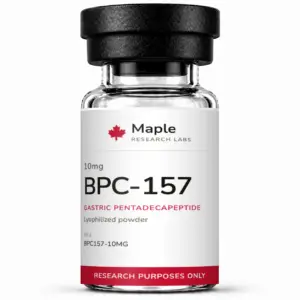
BPC-157 is a 15-amino-acid peptide with a relatively balanced composition and good aqueous solubility in water or saline at neutral pH. Its moderate hydrophobic content allows straightforward dissolution for most research applications.
GHK-Cu is a tripeptide-copper complex with high aqueous solubility due to its charged residues and small size. It dissolves readily in water, though researchers should note that the copper coordination affects UV absorbance readings used for concentration verification.
Semaglutide includes a C18 fatty acid chain modification that introduces amphiphilic character. While the peptide portion is hydrophilic, the acyl chain can promote self-association at higher concentrations. Dissolution in slightly acidic aqueous buffer (pH 4-5) typically achieves good results.
TB-500 (thymosin beta-4 fragment) is a larger peptide with good aqueous solubility due to its high proportion of charged and polar residues. Sterile water or bacteriostatic water provides adequate dissolution.
Verifying Dissolution Success
Visual clarity alone is insufficient to confirm complete peptide dissolution. Peptide nanoaggregates can be below the detection threshold of the human eye (typically >1 micrometer for visible turbidity) while still compromising experimental reproducibility. For critical experiments, researchers should consider:
- Dynamic light scattering (DLS): detects aggregates from 1 nm to several micrometers, providing a size distribution that reveals whether the peptide is monomeric or self-associated
- UV spectrophotometry at 280 nm: allows concentration verification for peptides containing tryptophan or tyrosine residues; comparing measured vs. calculated concentration reveals losses to aggregation or surface adsorption
- Centrifugation test: centrifuge an aliquot at 14,000g for 10 minutes and compare the UV absorbance of the supernatant to the pre-spin sample. A significant decrease indicates particulate aggregation.
Key Research Findings
- Peptides with >50% hydrophobic residues are frequently insoluble in aqueous solutions and require organic co-solvents (DMSO, ACN, or DMF)
- The isoelectric point (pI) is the pH of minimum solubility; dissolution pH should be at least 2 units away from pI for reliable results
- Hydrophilic peptides with >25% charged residues and <25% hydrophobic residues are generally water-soluble without co-solvents
- Peptides with >75% hydrogen bond-capable polar residues can form gel-like aggregates requiring chaotropic agents (6M guanidine HCl or 8M urea) to disrupt
- A practical design rule: 1 in every 5 residues should carry a charge at the target pH to maintain solubility
- Reconstituted peptides should be aliquoted immediately and stored at -20°C to -80°C to prevent aggregation from freeze-thaw cycling
- Visual clarity does not confirm dissolution; DLS, UV spectrophotometry, or centrifugation testing is needed for critical applications
Implications for COA Interpretation and Peptide Quality Assessment
Solubility behavior connects directly to peptide purity assessment. A peptide with reported HPLC purity of 98%+ should dissolve predictably based on its amino acid composition. If a peptide that should be water-soluble fails to dissolve, this may indicate degradation products, residual salts altering pH at the dissolution interface, or moisture-induced aggregation during storage. Reviewing the certificate of analysis (COA) for appearance, counterion identity, and net peptide content can help distinguish quality issues from dissolution technique problems.
Independent third-party testing through providers like Janoshik Analytical verifies not only purity by HPLC but also identity by mass spectrometry, giving researchers confidence that unexpected solubility behavior reflects formulation conditions rather than product misidentification. Learn more about HPLC vs. mass spectrometry verification methods and Maple Research Labs’ COA documentation standards.
For Canadian researchers sourcing lyophilized research peptides, consistent manufacturing quality and proper cold-chain shipping directly impact dissolution outcomes. Domestic Canadian suppliers with same-day shipping minimize transit time and temperature exposure that can compromise lyophilized peptide integrity before it ever reaches the laboratory.
For research purposes only. Not for human consumption. Not for diagnostic or therapeutic use.
Maple Research Labs provides research peptides vialed and fulfilled in British Columbia, submits manufactured batches to an independent laboratory for HPLC purity analysis and publishes the measured result for each tested batch on its Certificates of Analysis page, which also lists batches still awaiting a report. Orders ship same-day from Canada.
For peer-reviewed research on this topic, visit PubMed.
15% off your first order
Join the research list and we will email your code. New arrivals, current pricing, and research breakdowns. Unsubscribe anytime.