 Maple
Maple Peptide nitrosamine impurities are a class of mutagenic contaminants formed when a secondary amine in a peptide reacts with nitrite under acidic conditions. Because proline residues and unprotected N-terminal amines supply exactly the secondary amine chemistry that nitrosation requires, many common research peptides are structurally eligible to form them. Standard reversed-phase HPLC purity testing does not detect these species at the nanogram-per-gram levels regulators now consider meaningful.
This is an emerging analytical gap rather than a settled one. The regulatory framework for nitrosamines was built around small-molecule drug substances, and it has only recently extended to impurities that share structural features with the active molecule itself. Peptides sit awkwardly inside that framework. They are large, they carry multiple nitrosatable sites, and the reference standards needed to quantify their nitrosated derivatives frequently do not exist. Understanding where the science currently stands matters for anyone evaluating what a certificate of analysis does and does not cover.
What is a nitrosamine drug substance-related impurity?
The nitrosamine problem in pharmaceuticals began in 2018 with the detection of N-nitrosodimethylamine in valsartan products. Those early findings involved low molecular weight nitrosamines introduced through solvents, synthesis by-products, or nitrite carried into the finished product. The contaminant was a foreign molecule that happened to be present.
A second category emerged in 2021 with the identification of N-nitroso-varenicline. These are nitrosamine drug substance-related impurities, abbreviated NDSRIs. An NDSRI is not a foreign contaminant. It is the active molecule itself, nitrosated at one of its own amine groups. The distinction matters because an NDSRI is unique to a specific compound, which means no shared reference material exists, no shared analytical method applies, and in most cases no compound-specific carcinogenicity data has ever been generated.
The scale of the structural exposure is considerable. An in silico survey cited by Vogel and colleagues estimated that 40.4 percent of approximately 12,000 investigated drug molecules could theoretically form an NDSRI. That figure describes structural eligibility rather than observed contamination, but it establishes why regulators moved from case-by-case responses to a general framework.
Why peptide structure is relevant
Nitrosation at nitrogen requires a secondary amine and a nitrosating agent. The classical route is reaction with acidic nitrite, where nitrous acid or its anhydride generates the nitrosating species near pH 3. Tertiary amines are generally resistant because the reaction would require formation of a high-energy iminium intermediate followed by dealkylation. Primary amines nitrosate but the products are unstable and decompose rather than persisting as nitrosamines.
Peptides supply secondary amines in two structurally distinct ways. The first is proline. Proline is the only proteinogenic amino acid whose alpha-amino nitrogen is contained within a pyrrolidine ring, making it a secondary amine even when incorporated into a peptide chain. The second is the N-terminal residue in peptides that carry alkylated or cyclic terminal nitrogen.
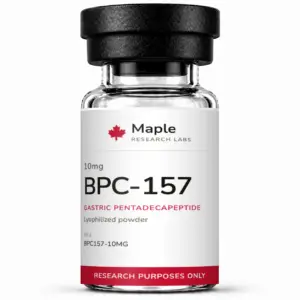
This is not an abstract concern for the compounds most commonly held in research inventories. BPC-157 has the sequence Gly-Glu-Pro-Pro-Pro-Gly-Lys-Pro-Ala-Asp-Asp-Ala-Gly-Leu-Val, placing four proline residues in a fifteen-residue chain. Selank, sequence Thr-Lys-Pro-Arg-Pro-Gly-Pro, carries three prolines across seven residues. Semax, Met-Glu-His-Phe-Pro-Gly-Pro, carries two. Proline-rich sequences are common in signalling peptides precisely because the pyrrolidine ring constrains backbone conformation, and that same ring is the structural feature nitrosation chemistry acts on.
Direct experimental work on proline-containing peptides is older than the current regulatory interest. Nebelin, Pillai, Lund and Thomsen, publishing in IARC Scientific Publications in 1980, reacted a series of proline-containing peptides with nitrite in weakly acidic aqueous systems. At pH 5.7 and pH 4.0 no N-nitrosopyrrolidine was detected from the linear peptides tested, with the cyclic dipeptide cyclo-(Pro-Pro) the sole exception. At pH 3.4, small amounts of N-nitrosopyrrolidine were recovered from every peptide in the series. The pH dependence is the important result. It indicates that peptide-bound proline is nitrosatable, and that whether it actually nitrosates depends heavily on the acidity of its environment.
Key Research Findings
- Vogel et al., Drug Testing and Analysis, 2025, volume 17, page 1772: thirteen secondary-amine-bearing active ingredients were incubated in artificial gastric juice at pH 3.15 with 200 micromolar sodium nitrite at 37 degrees Celsius for 2 hours, with quantification by validated LC-MS/MS.
- In that study only four of the twelve quantified compounds, namely hydrochlorothiazide, enalapril, folic acid and bumetanide, converted to their nitrosamine derivatives. Structural eligibility did not predict conversion reliably.
- The tertiary amine amitriptyline and the prodrug loratadine produced no detectable conversion under any tested condition, consistent with the mechanistic expectation that tertiary amines resist direct nitrosation.
- Calibration linearity in that work held with correlation coefficients above 0.99 even when the quantification range was extended tenfold beyond the validated upper limit of 5 nmol/mL.
- Aromatic secondary amines showed higher conversion than aliphatic counterparts, attributed to low protonation at pH 3.15. Enalapril was the notable exception, converting despite a predicted pKa of 5.43 that would leave it fully protonated at that pH.
- Nebelin et al., IARC Scientific Publications, 1980, number 31, pages 183 to 193: proline-containing peptides yielded N-nitrosopyrrolidine at pH 3.4 but not at pH 4.0 or 5.7, excepting cyclo-(Pro-Pro).
- Kruhlak et al., Regulatory Toxicology and Pharmacology, 2024, volume 150: the Carcinogenic Potency Categorization Approach assigns nitrosamines to one of five potency categories with acceptable intake limits spanning 18 to 1500 nanograms per day.
- Reported gastric nitrite concentrations in the reviewed literature ranged from roughly 1 to 200 micromolar, varying with food intake, health status, and microbial nitrate reduction in saliva.
How regulators assign an exposure limit
Because NDSRIs almost never have compound-specific carcinogenicity data, regulators needed a way to assign limits from structure alone. The result is the Carcinogenic Potency Categorization Approach, described by Kruhlak and colleagues in Regulatory Toxicology and Pharmacology in 2024. The CPCA is a rule-based structure-activity model. It examines the number and distribution of alpha-hydrogens adjacent to the N-nitroso centre, because alpha-hydroxylation is the metabolic activation step that produces the reactive diazonium species responsible for DNA alkylation. Activating and deactivating structural features adjacent to that centre adjust the assignment.
The model places a compound in one of five potency categories, each carrying an acceptable intake limit. The range runs from 1500 nanograms per day at the least potent end down to 18 nanograms per day at the most potent. The FDA has published recommended acceptable intake values for 247 NDSRIs derived this way.
Canadian and United States limits differ
The two jurisdictions diverge at the strictest category. Health Canada and the European Medicines Agency set the lowest CPCA category at 18 nanograms per day, consistent with the class-specific threshold of toxicological concern Health Canada applies as a default when compound-specific potency data is unavailable. The FDA sets its floor at 26.5 nanograms per day. The difference is modest in absolute terms but it reflects genuinely different default assumptions, and it means a Canadian regulatory assessment and a United States one can reach different conclusions on identical analytical data.
These figures are limits for finished medicinal products intended for human administration. They are cited here as the benchmark regulators use when judging analytical sensitivity, not as any statement about research materials. The relevant point for laboratory purposes is the order of magnitude. Nanograms per day is roughly one part per billion territory for a typical finished product, which is four to six orders of magnitude below what a chromatographic purity assay resolves.
Why HPLC purity does not answer this question
A reversed-phase HPLC purity result reports the proportion of the total ultraviolet-absorbing peak area attributable to the main peak. A typical research peptide certificate reports something in the range of 98 to 99 percent. The limit of quantification for a related impurity in such a method is usually somewhere around 0.05 to 0.1 percent of the main peak, which is 500 to 1000 parts per million.
A nitrosamine present at 1 part per billion sits roughly six orders of magnitude below that. It would not appear as a peak. It would not shift the reported purity value in any detectable way. A certificate reporting 99.1 percent purity by HPLC is not making a claim about nitrosamine content, and it is a category error to read it as one. This is the same structural limitation that applies to impurity reporting and qualification thresholds generally, but the magnitude of the gap is far larger here.
Detection at regulatory levels requires liquid chromatography coupled to tandem mass spectrometry operated in selected reaction monitoring, or high-resolution accurate-mass instrumentation. Both require a synthesised reference standard of the specific nitrosated derivative and a stable isotope labelled internal standard for reliable quantification. For a peptide with four proline residues and a free N-terminus, the number of possible mono-nitrosated positional isomers alone makes standard synthesis a substantial undertaking, and no compendial method currently covers it.
Where nitrite would come from
Nitrosation needs a nitrosating agent, and in pharmaceutical contexts nitrite is the usual source. Documented routes include nitrite present as a trace contaminant in excipients, residual nitrous acid or nitrite salts from synthesis and workup steps, and nitrogen oxide contamination in process water or compressed gases. Sodium nitrite is also used deliberately in some coupling and deprotection chemistries.
For lyophilised peptide powder held cold and dry, the practical risk is lower than for a formulated tablet, because nitrosation is a solution-phase reaction with strong pH dependence and the Nebelin data suggests proline-bound nitrogen requires quite acidic conditions to react appreciably. The conditions that raise the question are acidic reconstitution buffers, formulations containing nitrite-bearing excipients, and prolonged storage in solution. This intersects directly with established guidance on impurity profiling and analytical method selection, since the same solution conditions that promote hydrolysis and racemisation also govern nitrosation kinetics.
What this means for evaluating a certificate of analysis
The honest position is that essentially no research peptide supplier tests for nitrosamines, and that the analytical infrastructure to do so at regulatory sensitivity is not generally available outside pharmaceutical quality control laboratories. Any supplier claiming nitrosamine-free status without naming the method, the specific analyte, the reference standard used, and the limit of quantification is making a claim that cannot be evaluated.
What a certificate can legitimately establish is identity, chromatographic purity, water content, counterion content and residual solvents. Those are the parameters a third-party analytical report covers, and reading a batch certificate of analysis for what it actually measures rather than what it implies is the practical skill. For compounds with high proline content such as BPC-157, the structural eligibility for nitrosation is real, but structural eligibility is not the same as demonstrated contamination. The Vogel data makes that point directly: eight of twelve structurally eligible compounds did not convert under conditions specifically chosen to promote the reaction.
Open questions
Several things remain genuinely unresolved. No systematic survey of nitrosamine content in synthetic research peptides has been published. The CPCA was trained predominantly on small nitrosamines, and its extrapolation to molecules above 200 daltons has been questioned in the literature, with proposals circulating to add subcategories for higher molecular weight NDSRIs. Whether a nitrosated proline embedded in a peptide backbone is metabolically activated by the same alpha-hydroxylation pathway as a free cyclic nitrosamine has not been established experimentally.
Those gaps argue for accurate description rather than either alarm or dismissal. The chemistry is well characterised, the regulatory framework exists, the analytical methods exist in principle, and the specific data for peptides does not. That is worth stating plainly, because the alternative is a market where suppliers compete on claims nobody can verify.
Nitrosamine risk sits alongside the other impurity classes a purity percentage does not describe. The same reasoning applies to residual solvents measured by GC headspace, and the records question behind any of these figures is examined in peptide COA data integrity. Where a reported result falls outside its acceptance criteria, out-of-specification investigation rules govern what a supplier may legitimately do next.
For research purposes only. Not for human consumption. Not for diagnostic or therapeutic use.
15% off your first order
Join the research list and we will email your code. New arrivals, current pricing, and research breakdowns. Unsubscribe anytime.
Pingback: Research Peptide Purity: Why 98%+ Matters and How to Verify