 Maple
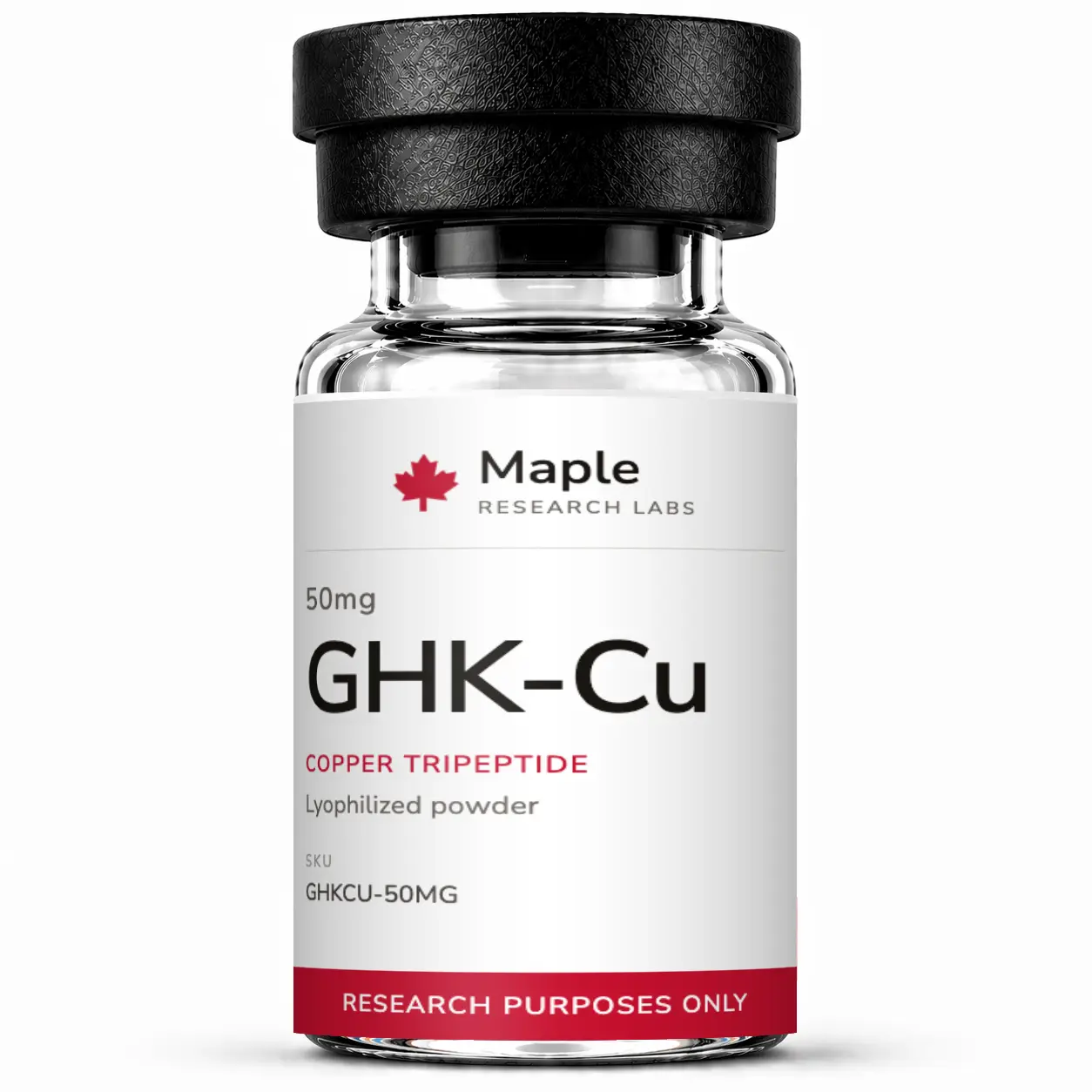
Answer first: GHK-Cu (copper tripeptide-1; CAS 49557-75-7) is the tripeptide glycyl-L-histidyl-L-lysine coordinated to copper(II), supplied by Maple Research Labs as a lyophilised research reagent in vial formats for laboratory use only. The Certificates of Analysis page indexes a GHK-Cu report under GHK-Cu 50MG. Its results describe the tested sample, not proof of 100mg or current-stock coverage. Maple vials do not carry printed lot or batch numbers. This material is for research use only — not for human consumption, not for diagnostic or therapeutic use.
Last reviewed: November 2026. Published report coverage is sample-specific; consult the COA index for available reports and do not assume linkage to the lot currently shipping.
Product Specifications
| Compound | Glycyl-L-histidyl-L-lysine copper(II) complex (GHK-Cu / copper tripeptide-1) |
| CAS number | 49557-75-7 |
| Molecular formula | C14H23CuN6O4 |
| Molecular weight | Approximately 402.9 Da |
| Form | Lyophilised powder |
| Available sizes | See product options on this page (vial and multi-pack formats as listed) |
| Analysis | HPLC-UV; results apply to the tested sample described in the report indexed under GHK-Cu 50MG. |
| Fulfillment | Packaged and shipped from British Columbia; orders by 2 PM PT (Mon–Fri) ship same business day when stock and verification allow |
| Intended use | Research use only (RUO) |
Freshness / verification
Consult the COA library for the report indexed under GHK-Cu 50MG. Review the tested sample, method, date and results, and use a laboratory verification route where available. The report does not establish 100mg or current-stock coverage. Vials do not carry printed lot or batch numbers.
Canadian shipping: $9.95 flat, free at $350+ after discounts (confirm live cart rates).
GHK-Cu Research Summary
GHK was first identified in the early 1970s as a tripeptide sequence present in human plasma, originally isolated during work on factors that influence hepatocyte behaviour in culture. The sequence occurs within the alpha-2 chain of type I collagen and within the plasma protein SPARC, which is one reason it appears in the literature as a fragment released during tissue remodelling. Copper(II) binds the histidine imidazole and the terminal amine groups with high affinity, and it is the copper complex rather than the free tripeptide that has been the focus of most published research.
Reported plasma levels of GHK in humans decline with age in the published literature, and that observation is what drove the bulk of subsequent in vitro and animal investigation into the complex as a research tool for copper transport and matrix biology.
Mechanism of Action Research
The mechanism under investigation has two components. The first is copper delivery: GHK-Cu is studied as a physiological carrier that exchanges copper(II) with cellular copper-binding proteins, making bioavailable copper accessible to enzymes such as lysyl oxidase and superoxide dismutase without the free-ion toxicity associated with inorganic copper salts.
The second is transcriptional. Gene expression profiling has been used to characterise the response of cultured human cells to the complex, and published analyses report modulation of large numbers of genes associated with extracellular matrix turnover, antioxidant response and inflammatory signalling. In fibroblast culture, researchers have reported changes in collagen and glycosaminoglycan synthesis and in the balance of matrix metalloproteinases against their tissue inhibitors.
Rodent dermal tissue work has examined extracellular matrix composition, including the expression of glycosaminoglycans and small proteoglycans. Separate in vitro lines of investigation have looked at antioxidant and metal-chelating behaviour, and at the complex as a probe for copper homeostasis in neuronal and hepatic cell models.
Preclinical Study Summary
The published GHK-Cu literature is dominated by in vitro fibroblast and keratinocyte culture work and by rodent dermal tissue models, with a smaller body of work on gene expression profiling and on copper coordination chemistry. Reported endpoints include matrix protein synthesis, gene expression signatures, antioxidant activity in cell-free and cell-based assays, and histological observations in animal tissue models.
All findings referenced here come from animal models and in vitro systems. No human therapeutic conclusion is drawn or implied. Researchers should consult the primary literature for experimental design, controls and complete results.
References
- Pickart L, Margolina A. Regenerative and Protective Actions of the GHK-Cu Peptide in the Light of the New Gene Data. Int J Mol Sci. 2018;19(7):1987 (PubMed)
- Siméon A, et al. Expression of glycosaminoglycans and small proteoglycans in wounds: modulation by the tripeptide-copper complex glycyl-L-histidyl-L-lysine-Cu(2+). (PubMed)
Handling and Storage
Store the sealed lyophilised vial at −20°C, protected from light. In solution the complex is less stable than the dry powder and is held refrigerated at 2 to 8°C for short periods only. Copper complexes are sensitive to chelating buffers, so researchers should check buffer compatibility before preparing stock solutions. Follow your facility’s laboratory protocol.
Frequently Asked Questions
What is GHK-Cu?
GHK-Cu is glycyl-L-histidyl-L-lysine coordinated to copper(II), also catalogued as copper tripeptide-1 (CAS 49557-75-7). Maple supplies it as a lyophilised research reagent for laboratory use only.
What is the CAS number for GHK-Cu?
49557-75-7. It also appears in catalogues as copper tripeptide-1.
How is GHK-Cu purity tested at Maple?
The COA index links report DBAV-GHK-Cu-50-062226 under GHK-Cu 50MG. It reports HPLC-UV relative-area purity of 99.56% and measured mass of 53.18mg for the tested sample. The PDF states no expected content or fill accuracy. It does not establish 100mg or current-stock coverage. Vials do not carry printed lot or batch numbers.
Is GHK-Cu the same as GHK?
No. GHK is the free tripeptide. GHK-Cu is that tripeptide coordinated to copper(II). Most published research concerns the copper complex, and the two are not interchangeable in an experimental design.
What is GHK-Cu studied for in research?
Published work centres on copper transport, extracellular matrix turnover in fibroblast culture, gene expression profiling, antioxidant chemistry, and tissue remodelling in rodent models. This is not a claim of human benefit.
Is GHK-Cu for human use?
No. Maple’s GHK-Cu is sold for research purposes only. Not for human consumption. Not for diagnostic or therapeutic use.
For research purposes only. Not for human consumption. Not for diagnostic or therapeutic use.
Join the research list
New arrivals, current pricing, and research breakdowns, every few days. Unsubscribe anytime.