 Maple
Maple ISO 17025 accreditation scope, not accreditation status, determines whether the purity figure on a peptide certificate was produced under accredited conditions. A testing laboratory can hold entirely valid ISO/IEC 17025 accreditation while the specific method that generated your number sits outside the list of activities its accreditation body actually assessed. The phrase “tested by an accredited laboratory” is a statement about the organisation, not about the measurement.
That gap is not a technicality. Accreditation under this standard is granted activity by activity, and the document that records which activities were assessed is a separate artifact from the certificate a supplier publishes. Across the research peptide market the word accredited is used as an unqualified adjective, attached to a laboratory name and left to do persuasive work it was never designed to do. What follows is what the standard actually grants, what the published evidence says accreditation is worth, and which questions resolve the difference.
What ISO/IEC 17025 accreditation actually certifies
ISO/IEC 17025:2017, General requirements for the competence of testing and calibration laboratories, is a conformity assessment standard rather than a corporate quality badge. An accreditation body, itself operating under ISO/IEC 17011:2017 and subject to peer evaluation before it can sign the ILAC Arrangement, assesses a laboratory against the standard and grants accreditation for a defined set of activities. Those activities are enumerated in a scope document that exists independently of any individual test report.
Competence under this standard is method specific and matrix specific, and the assessment structure reflects that. A laboratory judged competent to determine elemental impurities in drinking water by inductively coupled plasma mass spectrometry has demonstrated nothing about its ability to resolve a deletion sequence from a target peptide by reversed phase liquid chromatography. The equipment differs, the calibration chain differs, the analyst training differs, and the characteristic failure modes differ. Accreditation bodies therefore evaluate each declared activity on its own terms rather than certifying general laboratory virtue.
ILAC, the International Laboratory Accreditation Cooperation, publishes ILAC-G18:01/2024, Guideline for describing Scopes of Accreditation, precisely because the description of what a laboratory may do carries the entire informational weight of the accreditation. A scope entry ordinarily names the test method or standard, the edition of that method, the measurand, the matrix, and frequently a measurement range. Every one of those qualifiers is capable of excluding a given sample.
The scope document is the real credential
Reading a scope properly means checking that the exact method, edition and parameter appear, rather than accepting that a related technique is implied. A scope listing a chromatographic purity procedure for a named pharmacopoeial substance does not silently extend to an unrelated synthetic peptide. A scope covering identity confirmation by mass spectrometry does not extend to quantitative content determination. The reasonable default is that anything not written down was not assessed.
The same logic governs the ILAC MRA Mark, which signals that a result is recognised across signatory economies under the ILAC Arrangement. That mark may only be applied to activities falling within the signatory scope, and a laboratory must obtain permission from its accreditation body before using it at all. A mark appearing on work outside scope is a misuse of the mark rather than a stronger claim, which means the presence of a logo is not self validating and has to be checked against the scope listing held by the accreditation body.
Key Research Findings
- Middlebrook (Accreditation and Quality Assurance, 2017, volume 22, pages 111-117) analysed the Canadian Association for Laboratory Accreditation proficiency testing programme across 252 analyte and matrix combinations, 14,844 individual data sets and 1,124,630 participant results, retaining only data sets containing at least ten results from accredited and ten from non-accredited laboratories.
- In every partition examined in that analysis, including inorganic, organic and microbiological subsets, the percentage of both Questionable and Unsatisfactory z-score performance was higher among non-accredited laboratories than among accredited laboratories.
- Those z-scores were calculated using Algorithm A from ISO 13528:2015 and applied to all reported results regardless of accreditation status, with the CALA programme itself in continuous operation since 1991.
- de Oliveira Pereira and colleagues (Accreditation and Quality Assurance, 2017, volume 22, pages 63-72) contacted 68 Brazilian pharmaceutical laboratories, of which only 5 held ISO 17025 accreditation, and 13 registered as participants, of which 2 were accredited.
- Of the 11 participants that reported results in that scheme, all used the same United States Pharmacopeia official method, and 1 laboratory, representing 9.1 percent of participants, returned an unsatisfactory z-score.
- The same review identified three proficiency testing providers operating in the Brazilian pharmaceutical sector between 2002 and 2015, none of which was accredited to ISO 17043.
- ISO/IEC 17025:2017 clause 7.7.2 requires an accredited laboratory to monitor its performance by comparison with other laboratories through proficiency testing or interlaboratory comparison, where such activities are available and appropriate.
- ILAC-P9:01/2024 requires an accreditation body to assess a laboratory’s proficiency testing participation plan before granting accreditation, and to assess evidence of prompt corrective action wherever satisfactory performance is not achieved.
What the proficiency testing evidence shows
The strongest published test of whether accreditation predicts analytical performance comes from an accreditation body that also runs a proficiency scheme, which allows every submitted result to be tagged by accreditation status. Middlebrook’s examination of the CALA programme is unusually large for this literature, and after filtering to data sets with meaningful representation on both sides it retained more than 1.1 million participant results spanning 252 analyte and matrix combinations. Across the aggregate data and across each subset examined, accredited laboratories produced a lower proportion of Questionable and Unsatisfactory z-scores than non-accredited laboratories, and the pattern held when the analysis was extended to repeated unsatisfactory performance on the same analyte over a ten year window.
The published abstract reports that direction consistently rather than a single headline percentage gap, and it is worth being precise about that limit rather than inventing a number. The defensible reading is that accreditation status is a real and repeatable predictor of performance across a very large sample, not that it converts a laboratory into an infallible one. Earlier work in the same journal, including Thompson and colleagues on the relationship between accreditation status and proficiency test performance (Accreditation and Quality Assurance, 2009, volume 14, pages 73-78), examined the same question on smaller data and belongs to the same body of evidence.
The Brazilian survey supplies the counterweight. Eleven laboratories all running the identical United States Pharmacopeia procedure on the same prepared material still produced one unsatisfactory result, a 9.1 percent failure rate among participants who had opted into a scheme voluntarily and therefore represented a self selected and relatively motivated group. The same paper found that only 5 of 68 laboratories contacted in that sector held ISO 17025 accreditation at all, and that not one of the three proficiency providers operating over a thirteen year period met ISO 17043. Accreditation is a floor that raises the average. It does not eliminate the tail.
Accreditation is a continuing obligation, not a single audit
A common misreading treats accreditation as an event with a certificate date attached. The standard treats it as an ongoing demonstration. Clause 7.7.2 of ISO/IEC 17025:2017 requires the laboratory to monitor the validity of its results by comparison against other laboratories, through proficiency testing where a suitable scheme exists and through other interlaboratory comparison where it does not. ILAC-P9:01/2024 converts that into an obligation on the accreditation body as well, which must assess the participation plan before granting accreditation, ensure the plan remains representative of the accreditation scope, and examine corrective action whenever performance falls short.
The mechanics are more granular than a simple annual test. Under the guidance summarised in ILAC-P9, a laboratory groups its activities into areas of technical competence, defined so that performance demonstrated on one method, characteristic and product combination can be justifiably extended to related combinations within that area. The laboratory then sets a frequency of participation informed by risk factors including staff turnover, method complexity, analyte stability and the consequences of an incorrect result. A supplier claiming accredited testing is implicitly claiming that this machinery is running behind the number, which is a checkable assertion.
One practical note on provider competence. Proficiency providers are themselves assessed against ISO/IEC 17043, revised in 2023, with the 2010 edition remaining valid until May 2026. Reference material producers fall under ISO 17034:2016. A comparison exercise run by an unassessed provider carries correspondingly less weight, which is exactly the deficiency the Brazilian review documented.
Endorsed and non-endorsed reports
The most actionable consequence of scope is that an accredited laboratory issues two kinds of report. Work performed within scope can be reported bearing the accreditation body’s symbol, an endorsed report, and the reporting requirements of clause 7.8 apply in full to it. The same laboratory can also issue a report without that symbol for work outside its accredited scope, for a method it has not submitted for assessment, or for an informal request. Both documents come from the same building and the same instruments. Only one of them asserts that an accreditation body assessed the competence behind the result.
This is where certificates in the research peptide market tend to go quiet. A report naming a laboratory, listing a purity percentage and reproducing a chromatogram may be entirely genuine and still carry no accreditation symbol, no accreditation body name and no accreditation number. Nothing about that is dishonest on the laboratory’s part. The overstatement happens downstream, when the report is described in marketing copy as accredited testing. Clause 7.8.2.1 also requires the report to state that results relate only to the items tested, a reminder that a certificate describes the material that reached the bench and nothing else, a limitation explored further in our discussion of how falsified certificates of analysis survive scrutiny.
Why the distinction bites harder for research peptides
Two structural features of peptide analysis amplify the problem. The first is that a chromatographic purity percentage is a method output rather than a molecular constant, so the identity of the method and the competence behind it are load bearing rather than incidental. That dependency is set out in detail under the validation framework described in ICH Q2(R2) analytical method validation, which specifies the characteristics a procedure must demonstrate before its output means anything at all.
The second is that peptide purity is genuinely difficult to measure, not merely tedious. International comparison exercises among national metrology institutes have shown systematic disagreement on identical material, driven by shared analytical blind spots rather than random error, as covered in our review of peptide reference standards and why laboratories disagree on purity. When the best resourced laboratories in existence diverge on the same sample, the competence question stops being bureaucratic.
There is also a gap worth naming plainly. The proficiency literature discussed here comes from environmental, clinical and pharmaceutical sectors with mature scheme infrastructure. No comparable public proficiency programme exists for synthetic research peptide purity. A laboratory serving this sector may participate in relevant schemes for its underlying techniques, but the sector specific comparison that would most directly validate peptide purity numbers largely does not exist, and no amount of certificate reading substitutes for it.
Applying this when you read a certificate
The useful questions are narrow and answerable. Which accreditation body granted the accreditation, and what is the accreditation number, since both are needed to look the laboratory up in a public register rather than taking a logo on trust. Does the scope listing held by that body include the specific method, edition and matrix used for the peptide in question, rather than a neighbouring technique. Is the report itself endorsed, meaning it carries the accreditation symbol, or is it a plain report from an accredited laboratory covering unaccredited work. Does the laboratory participate in proficiency testing for the area of technical competence that covers this method, and what has its recent performance been.
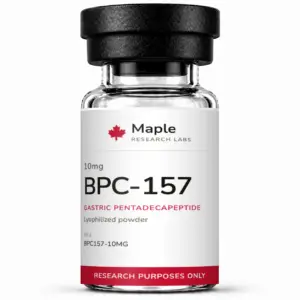
None of that displaces the more basic checks. A certificate must still be specific to the batch in the vial, must still resolve to a record held by the issuing laboratory rather than the vendor, and must still be read alongside what it does not measure, since a purity figure says nothing about counterion load, water content, endotoxin burden or residual solvent unless those were separately requested. Maple Research Labs publishes third party analytical documentation batch by batch through its certificates of analysis library, and individual listings such as BPC-157 link the supporting report for the specific lot so the number can be traced to the material it describes.
Limitations and open questions
The evidence assembled here supports a modest claim rather than a strong one. Accreditation status correlates with better proficiency performance across a very large multi sector data set, and it imposes a documented obligation to keep comparing results against other laboratories. It does not certify any individual number, it does not extend beyond the listed scope, and it demonstrably does not prevent unsatisfactory results even among laboratories running an official pharmacopoeial method on identical material. Reading accreditation as a guarantee inverts what the standard offers, which is a structured and auditable reduction in risk.
The most significant open question is the absence of peptide specific proficiency infrastructure. Until a recognised scheme distributes homogeneous synthetic peptide material to commercial laboratories serving this market and publishes performance distributions, claims about the comparability of peptide purity numbers between laboratories rest on metrology exercises conducted on model compounds by institutions that are not commercial testing laboratories. That is a reasonable lower bound on the disagreement to expect. It is not a measurement of it.
Research use statement
For research purposes only. Not for human consumption. Not for diagnostic or therapeutic use. The material discussed in this article concerns analytical quality systems and laboratory accreditation frameworks. Nothing here describes or recommends any use of research compounds in humans.
15% off your first order
Join the research list and we will email your code. New arrivals, current pricing, and research breakdowns. Unsubscribe anytime.
Pingback: Peptide Retest Period: What ICH Q1E Extrapolation Allows
Pingback: Analytical Method Transfer Between Peptide Testing Laboratories: USP 1224, WHO TRS 1044 and ICH Q14 - Maple Research Labs