 Maple
Maple Peptide bioavailability research in preclinical models shows that the route of administration changes how much of a peptide reaches the systemic circulation, how fast it gets there, and which tissues see it first. Unmodified peptides are cleared by proteolysis within minutes to hours and cross membranes poorly, which is why oral exposure is usually negligible and why subcutaneous, intraperitoneal and intranasal routes dominate animal-model work (Diao and Meibohm, 2013, Clinical Pharmacokinetics 52:855-868). This article summarises what the peer-reviewed pharmacokinetic literature actually establishes about each route in laboratory rodents, where the published data are thin, and why the identity and purity documented on a batch Certificate of Analysis matter for reproducibility once a route has been chosen.
Why route selection shapes peptide bioavailability research
Diao and Meibohm (2013) define therapeutic peptides as polymers of fewer than 50 amino acids and under 10 kDa, and describe a pharmacokinetic profile that sits between small molecules and full proteins. Unmodified peptides undergo extensive proteolytic cleavage, giving short plasma half-lives. Their low membrane permeability and catabolic susceptibility leave oral bioavailability very limited, so they are administered intravenously, subcutaneously or intramuscularly, with nasal delivery used for some compounds. Distribution is driven mainly by diffusion and, to a lesser degree, convective extravasation that depends on peptide size, and volumes of distribution are frequently no larger than the extracellular space. Every one of those properties interacts with the route, which is why two studies using the same compound by different routes can report different exposure and different effects without either being wrong.
Turner and colleagues (2011, Journal of the American Association for Laboratory Animal Science 50:600-613) make the practical point that route selection in laboratory animals is a planning decision, not a default. Once a route is chosen, the volume administered, the site, the pH of the preparation and personnel competency all need to be defined, and inadequate attention to those details produces adverse effects in the animals and confounded results. For peptide work the consequence is direct: a poorly controlled route introduces exposure variability that no amount of downstream assay precision can recover.
Subcutaneous administration in animal models
The subcutaneous route is the most common choice for peptides in rodent studies because absorption from the hypodermis is gradual and produces sustained plasma concentrations rather than the sharp peak of an intravenous bolus. Richter, Bhansali and Morris (2012, The AAPS Journal 14:559-570) reviewed the mechanistic determinants of biotherapeutic absorption after subcutaneous administration. A compound must first move through the extracellular matrix of the subcutaneous tissue, and during that transit it is exposed to what the authors call first-pass catabolism at the administration site. It then enters either the blood capillaries or the lymphatic vessels, with larger molecules favouring the lymphatic path. Compound properties such as charge and size, together with formulation and tissue factors, determine how much survives that journey. The authors are explicit that despite the commercial importance of the route, the available knowledge about subcutaneous absorption processes remains limited.
Kinnunen and Mrsny (2014, Journal of Controlled Release 182:22-32) extend that argument. They propose that the chemical, physical and physiological environment of the subcutaneous tissue determines the fate of an administered protein or peptide, because the molecule transitions abruptly from the non-physiological conditions of its formulation to the homeostatic conditions of the hypodermis. Stresses imposed during that transition, including pH shift, dilution and contact with matrix components, can drive aggregation or local degradation and explain why subcutaneous bioavailability outcomes are sometimes inconsistent or unexpectedly low. For a research design, the practical reading is that the reconstitution solvent, concentration and pH of a peptide preparation are pharmacokinetic variables, not just handling details. Our guide to reconstitution solvent selection and concentration covers the formulation side of this problem.
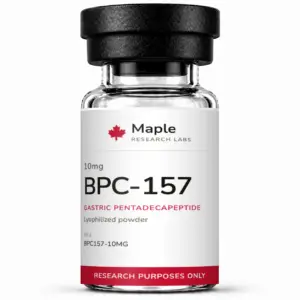
Published absolute bioavailability figures for specific research peptides by the subcutaneous route are sparse, and for compounds such as BPC-157 the primary literature reports pharmacodynamic outcomes in animal models rather than radiolabel pharmacokinetics. Claims of a precise subcutaneous bioavailability percentage for such compounds should be treated as unsupported unless a specific pharmacokinetic study is cited.
Intraperitoneal administration: convenient, but not equivalent to systemic delivery
Intraperitoneal administration is widespread in rodent studies because it is easy to learn, quick, suitable for chronic protocols and low in stress for the animal. Al Shoyaib, Archie and Karamyan (2019, Pharmaceutical Research 37:12) reviewed whether it belongs in experimental pharmacology at all. Their central observation is that the route is used far more often than it is understood: pharmacokinetic information on intraperitoneally administered agents is sparse, and the mechanisms by which compounds reach systemic exposure from the peritoneal cavity are rarely considered by the groups using it.
The mechanism matters for peptides. Compounds absorbed from the peritoneal cavity enter primarily through the mesenteric vasculature and pass through the portal circulation before reaching the systemic compartment, which exposes them to hepatic clearance that the subcutaneous route avoids. Absorption is typically faster than from the subcutaneous space, so peak concentrations arrive earlier, but the portal first pass means that a peptide susceptible to hepatic degradation can show lower total exposure than the same amount given subcutaneously. Al Shoyaib and colleagues conclude that the intraperitoneal route is justifiable for proof-of-concept and pharmacological studies where the question is whether a target is engaged, but that it is a poor surrogate when the study is meant to characterise systemic pharmacokinetics or translate to a clinically relevant route.
A second practical issue is technique. Turner and colleagues (2011) note that misplacement of intraperitoneally administered material is a recognised risk in rodents, and any misplaced fraction changes the effective exposure without any visible sign at the time. Groups that use the route for peptide studies should report the method, the operator training and the number of animals excluded, because those details explain much of the between-study variability in the literature.
Intranasal administration and nose-to-brain transport
Intranasal administration has attracted interest for neuropeptides because a fraction of nasally applied material appears to reach the brain directly through olfactory and trigeminal nerve-associated pathways, bypassing the blood-brain barrier. Lochhead, Wolak, Pizzo and Thorne (2015, Journal of Cerebral Blood Flow and Metabolism 35:371-381) used ex vivo fluorescence imaging in anaesthetised adult rats to show that fluorescently labelled 3 kDa and 10 kDa dextran tracers, after reaching the olfactory bulb or brainstem, distributed rapidly and widely within the brain by bulk flow along the perivascular spaces of cerebral blood vessels. Kumar and colleagues (2018, Journal of Controlled Release 286:467-484) then characterised distribution of radiolabelled and fluorescently labelled full-length IgG in rats 30 minutes after intranasal administration and found the highest concentrations in the olfactory bulbs, trigeminal nerves and leptomeningeal blood vessels with their associated perivascular spaces, with delivery to deeper brain regions at lower but measurable levels.
Two cautions follow from that work. The fraction reaching the brain is small relative to the amount applied, and the distribution is heavily weighted toward the olfactory bulb and trigeminal territory rather than uniform across the parenchyma. Quantitative brain-to-plasma ratios differ by molecule, formulation and technique, and the tracer studies above were designed to map mechanism rather than to generate benchmark numbers that can be transferred to an arbitrary peptide.
The Semax literature provides a peptide-specific example of intranasal pharmacodynamics. Dolotov and colleagues (2006, Brain Research 1117:54-60) reported that a single intranasal application of the heptapeptide in rats produced a maximal 1.4-fold increase in BDNF protein and a 1.6-fold increase in trkB tyrosine phosphorylation in the hippocampus, together with a 3-fold rise in exon III BDNF mRNA and a 2-fold rise in trkB mRNA, and that treated animals showed more conditioned avoidance reactions. The study measured downstream signalling rather than peptide concentration, so it demonstrates central effect after nasal administration without quantifying how much peptide reached the hippocampus. Our reviews of Semax neurotrophic mechanisms and Selank GABAergic modulation cover the preclinical evidence for both neuropeptides in more depth.
What the literature does not provide
Researchers looking for a table of route-specific bioavailability percentages that applies across research peptides will not find one in the primary literature, and figures of that kind that circulate online generally cannot be traced to a published study. Bioavailability is compound-specific and is shaped by sequence, size, charge, aggregation state, formulation and species, which is exactly the conclusion of the mechanistic reviews cited above. Where a precise number is needed for a given compound and route, it has to come from a pharmacokinetic study of that compound, and that study should be cited directly.
The same standard applies to half-life. Diao and Meibohm (2013) describe short plasma half-lives as the default for unmodified peptides, and strategies that extend circulation time, such as PEGylation and lipidation, change route-dependent behaviour as well. Our article on half-life extension strategies explains how those modifications alter absorption and clearance.
Why batch documentation matters once a route is chosen
Every mechanism above operates on the molecule as supplied. A truncated or deletion sequence absorbs and clears differently from the full-length peptide, an oxidised methionine changes receptor affinity, and aggregated material behaves differently at a subcutaneous site than dissolved monomer. If the identity and purity of a batch are not documented, route-dependent pharmacokinetic differences cannot be separated from batch-dependent ones. Our guides to reading a Certificate of Analysis, impurity reporting thresholds and degradation pathways explain which entries on a report bear on absorption behaviour.
Third-party analytical reports for tested batches are published on our Certificates of Analysis page, and the full research peptide catalogue lists the compounds currently available to Canadian laboratories. For a worked comparison of two tissue-repair peptides studied in animal models, see our BPC-157 vs TB-500 research comparison. Additional method references are collected in the documentation library.
For research purposes only. Not for human consumption. Not for diagnostic or therapeutic use.
For peer-reviewed research on this topic, visit PubMed.
15% off your first order
Join the research list and we will email your code. New arrivals, current pricing, and research breakdowns. Unsubscribe anytime.