 Maple
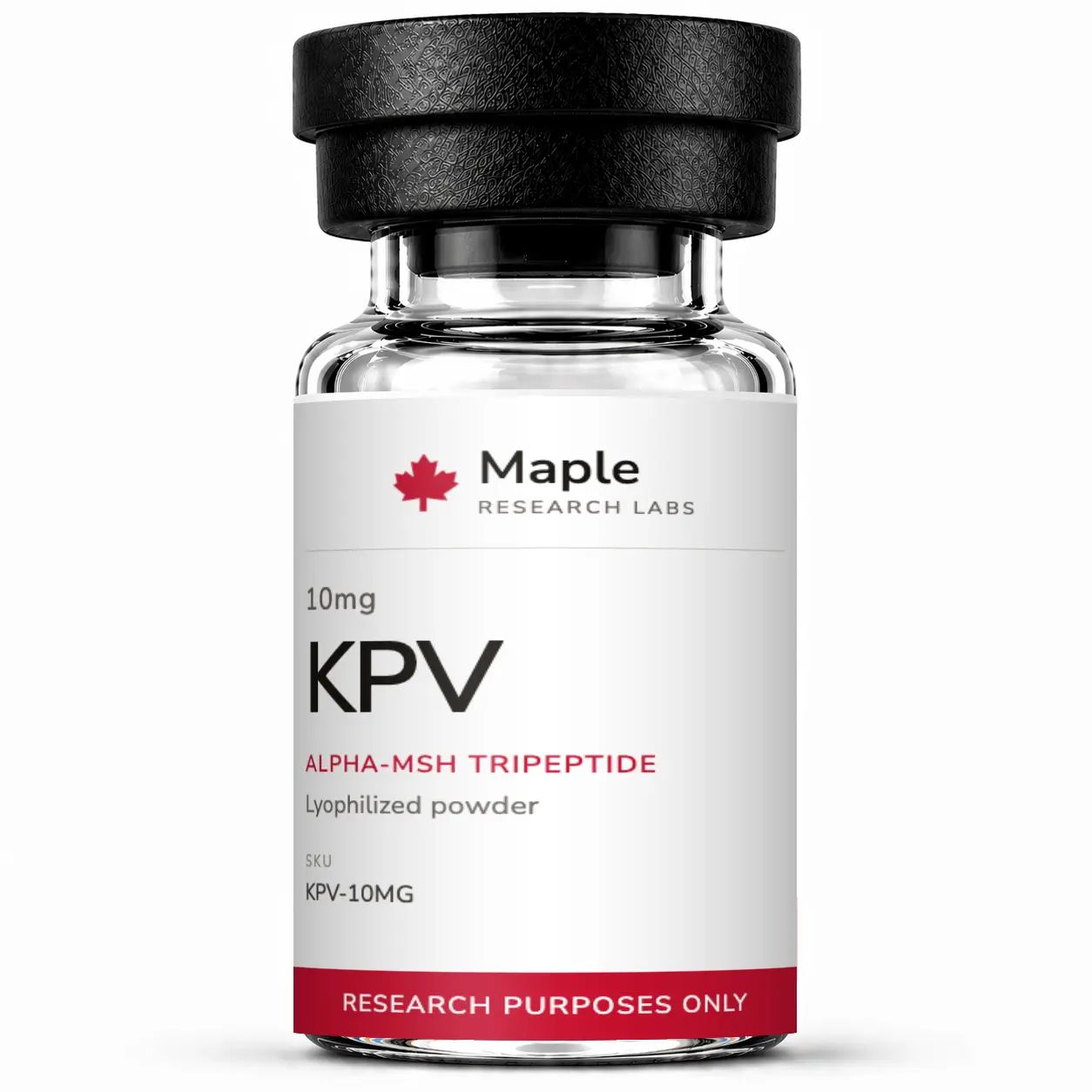
KPV peptide is the C-terminal tripeptide of alpha-melanocyte-stimulating hormone, Lys-Pro-Val, and it is studied because it retains the anti-inflammatory activity of the parent hormone without acting through melanocortin receptors. Report DBAV-KPV-10-062226 describes a tested 10mg KPV sample with 98.70% HPLC-UV relative-area purity; it does not establish the analysis of the vial supplied here. Supplied for laboratory research use only.
Compound Identity
KPV corresponds to residues 11 to 13 of alpha-MSH, the tripeptide Lys-Pro-Val. CAS number 67727-97-3, molecular formula C16H30N4O5, molecular weight approximately 358.4 daltons. At three residues it is one of the smallest peptides in active research use, which has practical consequences for analytical work: the molecule has no aromatic residue, so UV detection at 214 nm on the peptide bond is used rather than 280 nm.
Mechanism of Action
The mechanistic finding that defines the KPV literature is that it does not require melanocortin receptors. Dalmasso and colleagues (2008) showed in Caco2-BBE and HCT-116 intestinal epithelial cell models that KPV enters the cell through the di- and tripeptide transporter PepT1 (SLC15A1) and acts intracellularly, and that PepT1 knockdown abolished the effect. Once internalised it suppresses NF-kB signalling, reducing IKK activity and p65 nuclear translocation, with a corresponding fall in IL-8 and IL-6 secretion in stimulated cultures. Because PepT1 expression is upregulated in inflamed intestinal epithelium in animal models, uptake is concentrated where the inflammatory signalling is occurring.
This receptor-independent route distinguishes KPV from alpha-MSH itself, which signals through MC1R and MC3R. Researchers comparing the two mechanisms often run KPV against a melanocortin receptor agonist as a control arm, and our melanotan II melanocortin receptor pharmacology overview covers the receptor-mediated comparator.
Research Background
Cutuli and colleagues (2000) reported that alpha-MSH(11-13) exerts direct antimicrobial activity against Staphylococcus aureus and Candida albicans in culture, which was an early indication that the tripeptide fragment carries activity independent of the full hormone. Dalmasso and colleagues (2008) subsequently reported reduced disease severity in DSS and TNBS induced murine colitis models. Brzoska and colleagues (2008) reviewed the broader melanocortin-derived peptide literature and its application to inflammatory disease models. Work has continued in dermatological inflammation models and in delivery-system research where KPV is loaded into nanoparticle carriers to study targeted intestinal release.
A detailed account of NF-kB suppression, PepT1-mediated uptake and the published preclinical record is in our KPV peptide research article. KPV is also one of four components in our KLOW 80mg blend, alongside BPC-157, GHK-Cu and TB-500, for researchers working with multi-component formulations.
Analytical Verification
The tested 10mg KPV sample in report DBAV-KPV-10-062226 returned 98.70% HPLC-UV relative-area purity. This result alone does not establish the lot currently shipping. The certificate is downloadable from the product summary above, and the full catalogue index is on our certificates of analysis page. For context on why the reported figure matters more than a rounded marketing number, see our discussion of what a purity percentage actually represents.
Storage and Handling
Supplied as a lyophilized powder. Store sealed vials at minus 20 degrees Celsius for long-term storage, or 2 to 8 degrees Celsius for short-term. Protect from light and moisture, and allow vials to equilibrate to room temperature before opening to limit condensation. Short peptides are hygroscopic in the lyophilized state, so minimise the time vials spend open to ambient air.
Shipping
In-stock orders paid by 2 PM PT (Mon–Fri) ship the same business day, from BC with tracking. Full ordering and documentation details are on our documentation page, and the complete catalogue is at research peptides.
For research purposes only. Not for human consumption. Not for diagnostic or therapeutic use.
Join the research list
New arrivals, current pricing, and research breakdowns, every few days. Unsubscribe anytime.