 Maple
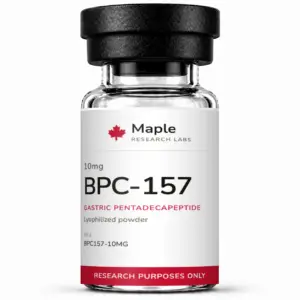
Maple BPC-157 (Body Protection Compound-157) is a synthetic pentadecapeptide derived from a segment of human gastric juice protein that has demonstrated broad cytoprotective and tissue-repair activity across more than 100 preclinical studies spanning gastrointestinal, musculoskeletal, neurological, and vascular research models. Its consistent activity across diverse tissue types, favorable tolerability in animal models, and novel mechanism involving NO system modulation and growth factor upregulation have made BPC-157 research one of the most extensively documented areas of preclinical peptide literature. For a direct comparison with another widely studied repair peptide, see the BPC-157 vs TB-500 research comparison.
Body Protection Compound-157, commonly referred to as BPC-157, is a synthetic pentadecapeptide derived from a protective protein found in human gastric juice. Over the past two decades, BPC-157 has become one of the most studied peptides in preclinical research, generating a substantial body of literature across multiple animal and in-vitro models. This article reviews the current state of BPC-157 research, its proposed mechanisms of action, and the key findings from published studies.
What Is BPC-157?
BPC-157 is a 15-amino-acid peptide (sequence: Gly-Glu-Pro-Pro-Pro-Gly-Lys-Pro-Ala-Asp-Asp-Ala-Gly-Leu-Val) that was first isolated and characterized from human gastric juice. Unlike many bioactive peptides, BPC-157 is stable in gastric acid, which has made it a subject of particular interest for gastrointestinal research.
The peptide does not occur naturally in this isolated form. It is a partial sequence of a larger protein called Body Protection Compound, which is present in gastric secretions. Researchers synthesize BPC-157 for laboratory use (see the reconstitution guide for handling protocols), typically as the acetate salt form, at purities exceeding 98% as verified by HPLC analysis, with batch-specific results documented in third-party certificates of analysis.
BPC-157 peptide research has expanded significantly since the early work of Sikiric et al. in the 1990s, with studies now spanning wound healing, gastrointestinal protection, musculoskeletal tissue repair (researchers may compare these findings with TB-500, another peptide studied in tissue repair models), and neurobiology.
BPC-157 Mechanism of Action: Current Understanding
The BPC-157 mechanism of action is not fully elucidated, but several converging lines of evidence point to a multi-pathway model. Research has identified the following primary mechanisms in preclinical settings. For a deeper treatment of the angiogenic signaling arm specifically, see the BPC-157 nitric oxide and VEGFR2 angiogenesis review.
Nitric Oxide System Modulation
One of the most consistently reported findings in BPC-157 research is its interaction with the nitric oxide (NO) system. Sikiric et al. (2014) demonstrated that BPC-157 modulates NO synthesis in various tissue models, appearing to counteract both NO-excess and NO-deficiency states. The peptide has been observed to normalize NO levels rather than simply increasing or decreasing them, suggesting a regulatory rather than stimulatory role (PMID: 24867541).
Growth Factor Upregulation
Multiple studies have reported that BPC-157 increases the expression of growth factors involved in tissue repair. In rat models, BPC-157 administration was associated with increased expression of vascular endothelial growth factor (VEGF), epidermal growth factor receptor (EGFR), and transforming growth factor-beta (TGF-beta). Chang et al. (2011) observed significant VEGF upregulation in tendon fibroblast cultures treated with BPC-157, correlating with enhanced angiogenesis in the surrounding tissue (PMID: 21030672). Researchers studying angiogenic mechanisms may also find the GHK-Cu copper tripeptide research a relevant parallel for growth factor-mediated tissue signaling.
FAK-Paxillin Pathway Activation
Research by Hsieh et al. (2017) identified the FAK-paxillin signaling pathway as a key mediator of BPC-157 activity in tendon healing models. This pathway is critical for cell migration and adhesion during tissue repair. The study found that BPC-157 promoted tendon fibroblast migration through activation of this pathway in a dose-dependent manner (PMID: 28268098).
Cytoprotective Properties
The original body protection compound research focused on gastric cytoprotection. BPC-157 has consistently demonstrated the ability to protect mucosal tissue against various insults in animal models, including ethanol, NSAIDs, and stress-induced damage (PMID: 8364845).
Key Areas of BPC-157 Studies
Gastrointestinal Research
The gastrointestinal tract is where BPC-157 research began, and it remains one of the most well-documented areas. Sikiric et al. (1999) published a comprehensive review of BPC-157’s effects on gastrointestinal lesions, documenting protective effects against ulcers induced by various agents in rat models. The peptide showed efficacy whether administered systemically or locally, and effects were observed across the esophagus, stomach, duodenum, and colon (PMID: 10421978).
A 2020 review by Seiwerth et al. compiled data from multiple studies confirming BPC-157’s protective role in inflammatory bowel disease models in rats, noting reduced lesion severity and accelerated mucosal healing across studies (PMID: 33670748).
Musculoskeletal Tissue Repair
BPC-157 studies in musculoskeletal models have generated considerable interest. Staresinic et al. (2003) demonstrated accelerated healing of transected quadriceps muscle in rats treated with BPC-157 compared to controls, with improved biomechanical properties in the healed tissue (PMID: 12911824).
Achilles tendon healing has been studied extensively. Pevec et al. (2010) showed that BPC-157 improved functional recovery and tendon-to-bone healing in a rat model of Achilles tendon detachment. Histological analysis revealed more organized collagen fibers and improved tendon structure in the treatment group (PMID: 20225319).
Bone healing has also been investigated. Sebecic et al. (1999) reported that BPC-157 promoted healing of segmental bone defects in rabbits, with radiographic and histological evidence of enhanced bone formation (PMID: 10421970). Researchers studying bone and connective tissue repair across multiple peptide models may also review the TB-500 actin dynamics and tissue repair research for a complementary mechanistic perspective.
Vascular and Angiogenic Effects
BPC-157 research has revealed consistent angiogenic properties across multiple models. Sikiric et al. (2018) published a review documenting BPC-157’s effects on blood vessel formation and vascular integrity. The peptide promoted formation of new blood vessels in chick embryo assays (CAM assay) and rat wound models (PMID: 29898107).
Notably, Vukojevic et al. (2018) demonstrated that BPC-157 could rescue tissue viability following arterial and venous ligation in rat models, suggesting a role in collateral vessel formation and vascular rescue pathways (PMID: 30248937).
Neurological Research
Preclinical neurological research on BPC-157 has expanded in recent years. Tudor et al. (2010) reported that BPC-157 demonstrated neuroprotective effects in a rat model of cuprizone-induced demyelination, with treated animals showing improved behavioral outcomes and reduced demyelination on histological analysis (PMID: 20388509).
Sikiric et al. (2010) reviewed dopaminergic system interactions, noting that BPC-157 counteracted behavioral changes induced by both dopamine agonists and antagonists in rat models. This bidirectional modulation pattern is consistent with findings in other systems, where BPC-157 appears to normalize rather than simply stimulate or inhibit (PMID: 22993353).
Wound Healing and Skin Research
BPC-157’s effects on wound healing have been documented in several studies. Mikus et al. (2001) demonstrated accelerated cutaneous wound closure in rats, with increased granulation tissue formation and angiogenesis in BPC-157-treated wounds compared to controls (PMID: 11440296).
Subsequent work by Tkalcevic et al. (2007) showed that BPC-157 enhanced burn wound healing in rats, with both systemic and topical application routes showing efficacy (PMID: 17685085).
Stability and Administration Routes in Research
One notable property of BPC-157 that has been confirmed across multiple studies is its stability in acidic environments. Unlike most peptides, BPC-157 retains biological activity after exposure to gastric acid conditions, which has implications for research protocols and study design (PMID: 10421978). For general guidance on maintaining compound integrity prior to use, see the research peptide storage and handling guide. Confirming identity and purity before a study begins matters just as much, and the reliability differences between third-party and in-house peptide testing are covered separately.
Limitations and Current Research Gaps
It is important to note several limitations in the existing BPC-157 literature: the majority of published studies originate from a single research group (Sikiric et al.), though independent replication studies have begun to appear. Nearly all data is preclinical, with no large-scale, peer-reviewed human clinical trials published to date. Long-term safety data in any model is limited, and standardization of research protocols varies between studies.
BPC-157 Canada: Sourcing for Research
For Canadian researchers working with BPC-157 peptide, sourcing is a critical consideration. Peptide purity, accurate molecular weight verification, and absence of contaminants directly affect experimental reproducibility.
At Maple Research Labs, all BPC-157 is supplied at greater than 98% purity, verified through independent third-party testing by Janoshik Analytical. Certificates of Analysis (COAs) are available for review, providing full transparency on purity, identity confirmation via mass spectrometry, and amino acid composition.
Browse the full research peptide catalog or review the documentation and verification standards.
The combination question comes up often enough to deserve its own article. BPC-157 and TB-500 combination research examines what the literature actually contains when the two peptides are studied together, which is largely single-agent data assembled by inference rather than controlled work on the pairing in one model, and sets out the study design consequences of building on separate datasets.
Disclaimer: This article is provided for educational and informational purposes only. BPC-157 is sold strictly as a research chemical and is not intended for human consumption, therapeutic use, or as a dietary supplement. All references describe preclinical research conducted in animal models or in-vitro systems. Nothing in this article constitutes medical advice, a treatment recommendation, or an endorsement of BPC-157 for any clinical application.
For research purposes only. Not for human consumption. Not for diagnostic or therapeutic use.
For peer-reviewed research on this topic, visit PubMed.
15% off your first order
Join the research list and we will email your code. New arrivals, current pricing, and research breakdowns. Unsubscribe anytime.
Pingback: BPC-157 vs TB-500 | Maple Research Labs