 Maple
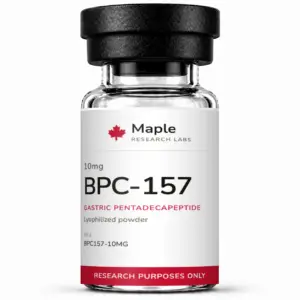
Maple BPC-157 and TB-500 are both tissue-repair peptides studied in preclinical research, but they work through fundamentally different mechanisms. BPC-157 primarily acts through nitric oxide pathways and growth factor modulation to promote gastrointestinal and musculoskeletal healing, while TB-500 (a synthetic fragment of Thymosin Beta-4) works through actin regulation and cell migration to support wound healing and reduce inflammation.
Researchers investigating tissue repair peptides will inevitably encounter two compounds that dominate the published literature: BPC-157 (Body Protection Compound-157) and TB-500 (a synthetic fragment of Thymosin Beta-4). Both have accumulated a substantial body of preclinical evidence, yet they operate through distinct mechanisms and have been studied in different experimental contexts.
This article provides a direct BPC-157 TB-500 comparison based on published animal studies, in-vitro experiments, and mechanistic research. The goal is to help researchers understand where these two peptides overlap, where they diverge, and what the existing evidence actually shows.
What Is BPC-157?
BPC-157, or Body Protection Compound-157, is a synthetic pentadecapeptide consisting of 15 amino acids. It is derived from a protective protein found in human gastric juice. The peptide was first characterized by researchers at the University of Zagreb in the early 1990s.
The sequence (Gly-Glu-Pro-Pro-Pro-Gly-Lys-Pro-Ala-Asp-Asp-Ala-Gly-Leu-Val) is notable for its stability in gastric acid, which is unusual for peptides of this size.
Key Areas of BPC-157 Research
Published preclinical studies on BPC-157 span a wide range of tissue types and injury models. Gastrointestinal tissue research includes rat models of gastric ulcers, inflammatory bowel disease, and esophageal damage, with Sikiric et al. (1999) demonstrating significant gastric lesion reduction (PMID: 10432034). Tendon and ligament repair studies by Chang et al. (2011) found that BPC-157 promoted tendon-to-bone healing in a rat rotator cuff model, with increased collagen fiber density and improved biomechanical strength (PMID: 21030672). Angiogenesis research by Seiwerth et al. (2018) reviewed evidence that BPC-157 promotes new blood vessel formation through modulation of the NO system and VEGF expression (PMID: 29898106). Neuroprotection research by Klicek et al. (2013) examined BPC-157 in models of peripheral nerve injury, with findings suggesting accelerated nerve regeneration in rats (PMID: 24186726).
The proposed mechanism of action centers on interaction with the nitric oxide (NO) system, upregulation of growth factor receptors (particularly VEGF and EGF), and modulation of several signaling pathways involved in tissue repair.
What Is TB-500?
TB-500 is a synthetic version of the active region of Thymosin Beta-4 (Tb4), a 43-amino-acid peptide that is naturally present in virtually all mammalian cells. Thymosin Beta-4 was first isolated from the thymus gland in the 1960s and has been studied for decades in the context of cell migration, wound healing, and inflammation.
TB-500 specifically replicates the actin-binding domain of Thymosin Beta-4, which is considered central to its biological activity. The molecular weight of full-length Thymosin Beta-4 is approximately 4,921 Da, making it considerably larger than BPC-157 (molecular weight approximately 1,419 Da).
Key Areas of TB-500 Research
The published research on Thymosin Beta-4 and its synthetic derivatives includes cardiac tissue repair, where Bock-Marquette et al. (2004) published a landmark study in Nature demonstrating that Thymosin Beta-4 promoted survival of cardiomyocytes after ischemic injury in mouse models (PMID: 15340220). Dermal wound healing research by Malinda et al. (1999) showed accelerated healing in aged mice, with increased angiogenesis and collagen deposition (PMID: 10469337). Corneal repair studies by Sosne et al. (2002) demonstrated anti-inflammatory and wound-healing properties in corneal epithelial cell models (PMID: 12490263). Hair follicle growth research by Philp et al. (2004) reported that Thymosin Beta-4 promoted hair growth in a mouse model by activating follicular stem cells (PMID: 14993237).
The primary mechanism of TB-500 involves its interaction with G-actin (globular actin), which plays a central role in cell motility and migration. By sequestering G-actin monomers and preventing premature polymerization, Thymosin Beta-4 facilitates the organized cell migration that is essential to wound repair.
BPC-157 vs TB-500: Head-to-Head Comparison
Molecular Structure
| Feature | BPC-157 | TB-500 |
|---|---|---|
| Amino acid length | 15 amino acids | Fragment of 43-amino-acid parent protein |
| Molecular weight | ~1,419 Da | ~4,921 Da (full Tb4) |
| Origin | Derived from human gastric juice protein | Synthetic fragment of Thymosin Beta-4 |
| Stability | High stability in acidic environments | Standard peptide stability profile |
Mechanism of Action
BPC-157 primarily interacts with the nitric oxide (NO) system and growth factor signaling. Research suggests it modulates both the NO synthase system and VEGF/EGF receptor expression, promoting angiogenesis and cytoprotection across multiple tissue types. Sikiric et al. (2014) proposed that BPC-157 acts as a modulator of the “Robert cytoprotection” concept, extending protective effects beyond the GI tract (PMID: 24662484).
TB-500 works primarily through G-actin sequestration, which regulates cytoskeletal organization and cell migration. This mechanism is distinct from growth factor modulation and instead operates at the level of cellular architecture. Goldstein et al. (2005) reviewed the role of Thymosin Beta-4 as a major actin-sequestering protein and its implications for cell motility (PMID: 15642004).
In simple terms: BPC-157 appears to signal tissues to repair by modulating growth factors and blood vessel formation, while TB-500 facilitates repair by enabling cells to move to the injury site and organize effectively.
Where Do They Overlap?
Both peptides have demonstrated pro-angiogenic properties and the ability to accelerate tissue repair processes in animal models. Both have shown effects across multiple tissue types rather than being limited to a single organ system. The overlap in angiogenesis and tissue repair has led some researchers to investigate whether the two peptides might produce complementary effects when studied together, given that their mechanisms are largely non-overlapping.
Combination Research: BPC-157 + TB-500
Because BPC-157 and TB-500 operate through distinct molecular pathways, there is scientific rationale for studying them in combination. BPC-157 modulates growth factor signaling and NO pathways, while TB-500 facilitates cell migration through actin regulation. In theory, these mechanisms could complement one another during the tissue repair cascade.
Limitations of the Current Evidence
Any honest assessment of BPC-157 and TB-500 research must acknowledge several limitations. The majority of BPC-157 studies originate from a small number of research groups, and independent replication by unaffiliated laboratories would strengthen the evidence base. Neither peptide has completed large-scale human clinical trials. Published studies examining BPC-157 and TB-500 together in controlled experimental designs are scarce. Dose-response variability across published studies makes direct comparisons challenging.
Sourcing Research Peptides in Canada
For researchers based in Canada, sourcing high-purity peptides with proper documentation is a practical concern that directly impacts study validity. Maple Research Labs publishes independent third-party Certificates of Analysis (COAs) for tested batches. Each listed compound shows its report number, lot, measured HPLC-UV purity and test date, and the page also lists the compounds still awaiting a certificate, so the purity of a specific lot of BPC-157 or TB-500 can be read directly rather than assumed from a blanket figure.
Browse individual BPC-157 and TB-500 products, or explore our full research peptide catalog.
Researchers designing protocols that involve both compounds should also review our discussion of BPC-157 and TB-500 combination research, which covers the confounding factors that arise when two repair-pathway peptides are studied in the same model.
Disclaimer: This article is intended for informational and educational purposes only. All peptides discussed are sold strictly for in-vitro research and laboratory use. They are not intended for human consumption, therapeutic use, or self-administration.
For research purposes only. Not for human consumption. Not for diagnostic or therapeutic use.
For peer-reviewed research on this topic, visit PubMed.
15% off your first order
Join the research list and we will email your code. New arrivals, current pricing, and research breakdowns. Unsubscribe anytime.
Pingback: Peptide Bioavailability Research | Maple Research Labs
Pingback: Follistatin-344 Peptide Research: Myostatin Neutralization, SMAD2/3 Pathway Inhibition, and Preclinical Muscle Growth Evidence - Maple Research Labs
Pingback: BPC-157 and TB-500 Combination Research | Maple Research Labs