 Maple
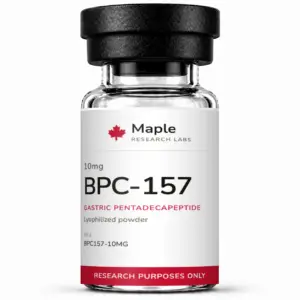
Maple BPC-157 (Body Protection Compound-157) is a synthetic pentadecapeptide derived from a protective protein found in human gastric juice, and it has become one of the most extensively studied peptides in preclinical research due to its multi-system cytoprotective activity involving nitric oxide modulation, VEGFR2-driven angiogenesis, and growth hormone receptor upregulation. Three decades of BPC-157 peptide research now span more than 500 articles indexed across PubMed, Cochrane, and Embase, with research output accelerating sharply since 2020. This post examines the core molecular pathways through which BPC-157 exerts its effects in animal models, the specific receptor interactions that distinguish it from other cytoprotective peptides, and the current state of translational research heading into 2026.
Sequence, Structure, and Stability Profile
BPC-157 comprises 15 amino acids with the sequence Gly-Glu-Pro-Pro-Pro-Gly-Lys-Pro-Ala-Asp-Asp-Ala-Gly-Leu-Val, corresponding to a partial sequence of a larger protein isolated from human gastric juice designated BPC. The molecular weight is approximately 1419 Da, and the compound carries a CAS number of 137525-51-0. Unlike many bioactive peptides that require carrier molecules or stabilization through PEGylation or fatty acid acylation to survive enzymatic degradation, BPC-157 demonstrates unusual stability in gastric juice at physiological pH. This intrinsic stability has been documented in studies by Sikiric and colleagues dating back to the early 1990s, and it distinguishes BPC-157 from peptides such as GHK-Cu or TB-500, both of which require careful handling to maintain bioactivity in solution.
The high proline content (three consecutive proline residues at positions 3 through 5) contributes to a polyproline II helical tendency that likely confers resistance to common serine and metalloprotease activity in the gastrointestinal tract. Researchers working with BPC-157 should note that lyophilized powder stored at -20°C maintains stability for extended periods, while reconstituted solutions should be kept refrigerated at 2 to 8°C and used within a defined experimental window consistent with standard peptide reconstitution protocols and general research peptide storage and handling practice.
Nitric Oxide System Modulation: The Central Regulatory Axis
The interaction between BPC-157 and the nitric oxide (NO) system represents what is arguably the most important mechanistic finding in the peptide’s research history. Work published across multiple laboratories has established that BPC-157 modulates all three nitric oxide synthase isoforms, but it does so in a context-dependent manner that appears to distinguish it from simple NO donors or NOS inhibitors.
In models of endothelial dysfunction, such as those induced by NSAID administration in rat gastric tissue, BPC-157 upregulates endothelial NOS (eNOS) expression and restores NO production. Sikiric et al. demonstrated that this restoration of NO signaling directly promoted angiogenesis and mucosal restitution in damaged tissue. The mechanism operates through the L-arginine-NO-cGMP pathway, where BPC-157 appears to act upstream of eNOS activation rather than simply supplying exogenous NO.
What makes this particularly interesting from a research perspective is the bidirectional nature of BPC-157’s NO modulation. In conditions where inducible NOS (iNOS) is pathologically elevated, such as in sepsis models or severe inflammatory states, BPC-157 has been shown to attenuate iNOS overexpression and reduce the cytotoxic NO burst that contributes to tissue damage. Conversely, when eNOS activity is suppressed, BPC-157 rescues it. This dual behavior has led researchers to describe BPC-157 as a “NO system modulator” rather than a simple agonist or antagonist, a classification that has significant implications for understanding its broad protective profile across diverse injury models.
The neuronal NOS (nNOS) interaction adds another dimension. Studies examining peripheral nerve injury in animal models have reported that BPC-157 upregulated nNOS expression at sites of axonal damage, which correlated with improved functional nerve recovery. The nNOS pathway is also implicated in BPC-157’s effects on gastrointestinal motility, where NO-mediated smooth muscle relaxation plays a role in the peptide’s documented antiulcer activity first described by Sikiric’s group in the 1990s.
VEGFR2-Mediated Angiogenesis and Wound Repair
Beyond the NO system, BPC-157’s pro-angiogenic activity through vascular endothelial growth factor receptor 2 (VEGFR2) represents a second major mechanistic pillar. In vitro studies using human umbilical vein endothelial cells (HUVECs) have demonstrated that BPC-157 promotes endothelial cell proliferation, migration, and tube formation, the three canonical steps of angiogenesis.
The signaling cascade appears to involve VEGFR2 phosphorylation leading to activation of the PI3K/Akt and MAPK/ERK pathways. These are the same downstream pathways activated by VEGF-A binding, but BPC-157 does not appear to act as a direct VEGF-A mimetic. Instead, current evidence suggests it upregulates VEGFR2 expression on endothelial cells and may enhance the receptor’s sensitivity to endogenous VEGF ligands. This indirect enhancement model would explain why BPC-157’s angiogenic effects are particularly pronounced in ischemic or damaged tissues where VEGF signaling is already active but insufficient.
In rat models of ischemic-reperfusion injury, BPC-157 administration accelerated collateral vessel formation and reduced infarct size compared to vehicle controls. Similar findings have been reported in tendon, ligament, and muscle injury models, where increased vascularization at the repair site correlated with improved biomechanical outcomes. The 2025 systematic review by Vasireddi et al. in the American Journal of Sports Medicine confirmed this pattern across multiple orthopaedic injury models, noting consistent improvements in functional, structural, and biomechanical parameters.
Growth Hormone Receptor and Growth Factor Pathways
A third mechanistic axis involves BPC-157’s documented upregulation of growth hormone receptor (GHR) expression. Studies have demonstrated increased GHR mRNA and protein levels in tissues exposed to BPC-157, which has downstream implications for IGF-1 signaling and the broader somatotropic axis. This mechanism may contribute to the peptide’s effects in musculoskeletal repair models, where GH/IGF-1 signaling plays a well-established role in tissue regeneration.
BPC-157 also modulates several other growth factor systems. Fibroblast growth factor (FGF) and epidermal growth factor (EGF) receptor expression have both been reported to increase following BPC-157 administration in wound models. The peptide’s effect on focal adhesion kinase (FAK) and paxillin phosphorylation, documented in fibroblast migration assays, provides a mechanistic link between growth factor receptor activation and the cellular mechanics of wound closure. Phosphorylated FAK localizes to focal adhesion complexes at the leading edge of migrating cells, and BPC-157’s enhancement of this process accelerates fibroblast ingress into wound sites independently of, but complementary to, growth factor signaling.
Researchers investigating the growth hormone secretagogue axis should note that BPC-157’s GHR upregulation represents a receptor-level mechanism distinct from the pituitary-level GH release promoted by peptides such as ipamorelin or CJC-1295. Where secretagogues increase circulating GH concentrations, BPC-157 appears to enhance target tissue responsiveness to GH that is already present.
GAP-43 Upregulation and Neuroprotective Mechanisms
BPC-157’s effects on the nervous system extend beyond nNOS modulation. The peptide upregulates growth-associated protein 43 (GAP-43), a well-established marker of active axonal sprouting and synaptic plasticity. GAP-43 is concentrated in neuronal growth cones during development and is re-expressed during regenerative responses following nerve injury in adult tissue. BPC-157’s ability to increase GAP-43 expression has been documented in models of peripheral nerve transection, crush injury, and spinal cord damage.
The neurotrophic effects appear to involve multiple complementary pathways. In addition to GAP-43 and nNOS, BPC-157 has been reported to modulate dopamine and serotonin systems. Studies in rat models have shown that BPC-157 counteracted dopamine system disruption induced by amphetamine or haloperidol administration, suggesting interactions with D2 receptor signaling. Serotonin system modulation has been documented in forced swim and tail suspension tests, standard preclinical assays for antidepressant-like activity.
These findings are relevant to researchers studying neuropeptides such as Semax and Selank, which also target neurotrophic and anxiolytic pathways but through distinct receptor mechanisms. Where Semax operates primarily through melanocortin receptor subtypes and BDNF modulation, and Selank through the tuftsin/IL-6 axis, BPC-157’s neurological effects appear to converge on GAP-43 and NO-mediated pathways, making comparative studies across these compounds a productive area of investigation.
Anti-Inflammatory Cytokine Profile
BPC-157’s cytoprotective activity includes documented effects on inflammatory cytokine expression. In models of acute and chronic inflammation, the peptide has been shown to reduce levels of pro-inflammatory cytokines including TNF-alpha, IL-6, and IL-1beta while maintaining or enhancing anti-inflammatory mediators such as IL-10. The net effect is a shift in the inflammatory balance toward resolution rather than propagation.
The anti-inflammatory mechanism appears to operate at least partly through the NO system, since NO itself is a regulator of NF-kB signaling, which controls transcription of many pro-inflammatory genes. However, direct effects on cytokine gene expression independent of NO modulation have also been reported, suggesting multiple parallel anti-inflammatory pathways. This multi-target anti-inflammatory profile distinguishes BPC-157 from single-pathway anti-inflammatory peptides such as KPV, which acts primarily through NF-kB suppression via melanocortin receptor activation.
Gastrointestinal Protection: The Original Research Domain
BPC-157 derives its name from its origin as a body protection compound isolated from gastric juice, and the gastrointestinal tract remains the most extensively studied organ system in BPC-157 research. The peptide has demonstrated gastroprotective effects in models of ethanol-induced gastric lesions, NSAID-induced ulcers, stress-induced mucosal damage, and inflammatory bowel disease analogs.
The gastrointestinal mechanism integrates the NO modulation, angiogenesis, and anti-inflammatory pathways described above into a coordinated tissue-level response. In ulcer models, BPC-157 accelerated mucosal restitution (the rapid migration of epithelial cells to cover denuded areas), promoted granulation tissue formation through VEGFR2-mediated angiogenesis, and reduced inflammatory infiltrate through cytokine modulation. The peptide also maintained intestinal barrier integrity in models of gut permeability disruption, an effect attributed to its influence on tight junction protein expression.
Researchers studying gastrointestinal peptides should note that BPC-157’s gastroprotective profile is mechanistically distinct from proton pump inhibitors or H2 receptor antagonists, which primarily reduce acid secretion. BPC-157 operates on the tissue repair and cytoprotection side of the equation, which is why it has shown efficacy in non-acid-dependent injury models such as alcohol and NSAID damage.
Musculoskeletal Repair Evidence
The orthopaedic research community has generated substantial preclinical data on BPC-157 in tendon, ligament, muscle, and bone injury models. The 2025 systematic review by Vasireddi and colleagues identified consistent findings across these tissue types, with BPC-157-treated groups showing improved tensile strength in tendon repairs, accelerated muscle fiber regeneration, enhanced ligament healing biomechanics, and increased callus formation in fracture models.
The musculoskeletal repair mechanism draws on BPC-157’s combined angiogenic, growth factor, and anti-inflammatory activities. Tendons and ligaments are notoriously slow-healing structures due to their limited vascular supply, so BPC-157’s pro-angiogenic effects through VEGFR2 are particularly relevant in these tissues. The FAK/paxillin-mediated acceleration of fibroblast migration adds a direct cellular repair mechanism that complements the vascular improvements.
The mechanistic differences between these two repair peptides are set out in detail in our BPC-157 vs TB-500 research comparison.
Comparative research with TB-500 (Thymosin Beta-4), another peptide extensively studied for tissue repair, reveals complementary but distinct mechanisms. TB-500 promotes actin sequestration and cell migration through a thymosin-specific pathway, while BPC-157 operates through the NO/VEGFR2/GHR axes described above. The BPC-157 + TB-500 blend available from Maple Research Labs reflects this mechanistic complementarity, and researchers studying connective tissue repair may find value in examining both pathways independently and in combination.
Current Research Trajectory and Translational Status
As of early 2026, BPC-157 research is transitioning from purely preclinical characterization toward early translational investigation. The first reported human IV safety pilot study by Lee and Burgess (2025) documented no adverse effects at doses up to 20 mg, with plasma clearance within 24 hours. While this represents only the earliest safety data, it marks a significant step in the compound’s research history after three decades of exclusively animal model work.
The volume of published research continues to accelerate. PubMed indexed over 180 BPC-157-related articles in 2025 alone, representing approximately a fourfold increase from the 45 results indexed in 2020. The 2025 patent and literature review by Jozwiak et al. in Pharmaceuticals cataloged the expanding intellectual property landscape around BPC-157, reflecting growing commercial and academic interest in the compound.
For researchers sourcing BPC-157 in Canada, verification of peptide purity and identity through independent certificates of analysis remains essential. HPLC purity assessment and mass spectrometry confirmation of molecular weight should be standard requirements for any BPC-157 used in experimental protocols. Batch analytical documentation should be reviewed alongside the analytical standards discussed in our guide to peptide impurity profiling.
BPC-157 is one of several peptides studied for tissue protection in rodent injury models. ARA-290, derived from erythropoietin’s helix B region, reaches a similar endpoint through the innate repair receptor rather than through nitric oxide or VEGFR2 signalling, and its preclinical record is reviewed separately.
For research purposes only. Not for human consumption. Not for diagnostic or therapeutic use.
For peer-reviewed research on this topic, visit PubMed.
15% off your first order
Join the research list and we will email your code. New arrivals, current pricing, and research breakdowns. Unsubscribe anytime.
Pingback: BPC-157 and TB-500 Combination Research | Maple Research Labs